

Health systems on Epic are consolidating document management into Epic Gallery, and the business case is straightforward: Gallery stores documents natively in the Epic ecosystem, inside the patient record and the clinician workflow. Keeping a separate enterprise content platform, for most organizations, Hyland OnBase, alongside Epic means duplicate licensing, duplicate infrastructure, and duplicate compliance overhead. Deciding to move is the easy part. The projects that stall almost never stall on the Epic side. They stall on the legacy side.
- 3.8M+Documents in a typical OnBase footprint
- 7Governed phases, each with an exit gate
- 100%Documents accounted for, nothing dropped
- 4–9 moTypical engagement, scoped after discovery
The Migration Nobody Budgets For
In 2026, the queue of providers waiting to make this move keeps growing. Historical documents must be extracted from OnBase, transformed into Gallery-compatible structures, validated, and prepared for ingestion before the Gallery timeline can hold. If extraction is queued, the Epic project is queued. The work is invisible on the roadmap right up until it becomes the critical path.
The migration is not a bulk export. It is a structured data conversion, and it deserves a conversion methodology.
Treating it as a file copy is where timelines slip. OnBase environments carry revision histories, annotations, overlays, e-forms, multiple file formats, and retained records, and not everything in OnBase even belongs in a patient-centric repository. The move only stays predictable when it is planned as a governed conversion from day one.
Four Realities of the OnBase-to-Gallery Move
Every OnBase footprint is different, but the same four truths shape almost every migration. Naming them early is what keeps discovery honest and the timeline intact.
-
Gallery is patient-centric
OnBase may also hold HR files, AP invoices, credentialing packets, and other administrative content. Because not all of it is meant for Gallery, organizations need a clear disposition and retention strategy for documents that will live outside the Epic patient record.
-
Document complexity requires planning
Revision histories, annotations, overlays, e-forms, multiple file formats, and retained records all behave differently. These characteristics should be identified during discovery so each document type is handled correctly, not discovered mid-extraction.
-
Extraction needs a controlled approach
Migrating large volumes while preserving metadata and document relationships requires throughput management, checkpointing, reconciliation, and verification. Planning this work early keeps it aligned with the overall Epic Gallery timeline.
-
Metadata is central
OnBase keyword schemas must be mapped accurately to Gallery document types and metadata, with HIM and clinical input, then validated through test loads. Verified mappings keep migrated documents searchable, accessible, and correctly associated in Gallery.

The InterScripts Migration Methodology
InterScripts approaches an OnBase-to-Gallery migration as a governed data conversion. A structured framework moves content from OnBase to its approved destination through a controlled, auditable pipeline, classify and inventory, map metadata, extract read-only, validate, and reconcile at the document level, with stakeholder approval before each step advances.
Inventory
Classify & inventory all content
Mapping
Map OnBase metadata to Epic Gallery
Extraction
Read-only, checkpointed, parallel extraction
Validation
Quality checks, metadata & format validation
Reconciliation
Document-level reconciliation & accountability
Each phase includes defined entry criteria, exit criteria, and documented deliverables. The gate between phases is not a formality, it is where a signed artifact proves the work is complete before the next phase can begin.
| Phase | Focus | Exit criteria |
|---|---|---|
| 1 · Discovery & Inventory | Classify document types, keyword schemas, volumes, relationships, and special handling before extraction begins. | Approved scope matrix with validated baseline counts. |
| 2 · Disposition & Mapping | Define the destination for each document class, Gallery, archive, or approved disposition, and map required metadata. | Approved disposition matrix and metadata mapping specification. |
| 3 · Extraction | Perform controlled, read-only extraction with checkpointing and parallel processing while OnBase remains operational. | Extracted counts reconciled to baseline; variances documented and resolved. |
| 4 · Transformation & Validation | Convert formats as required, preserve revision and annotation requirements, transform metadata, and manage exceptions. | Gallery-ready packages with critical exceptions resolved. |
| 5 · Ingestion & Reconciliation | Run test loads, then controlled production waves, with document-level reconciliation back to the source. | Complete document accountability and HIM acceptance sign-off. |
| 6 · Delta Sync & Cutover | Synchronize new or modified documents, complete final reconciliation, and transition capture workflows to Epic. | Final sync completed and OnBase transitioned per the approved cutover plan. |
| 7 · Archive & Decommission | Place non-Gallery content in the approved archive, enforce retention and legal hold, and complete the planned OnBase transition. | Archive certification completed and transition activities formally approved. |
The Seven-Phase Journey, Gate by Gate
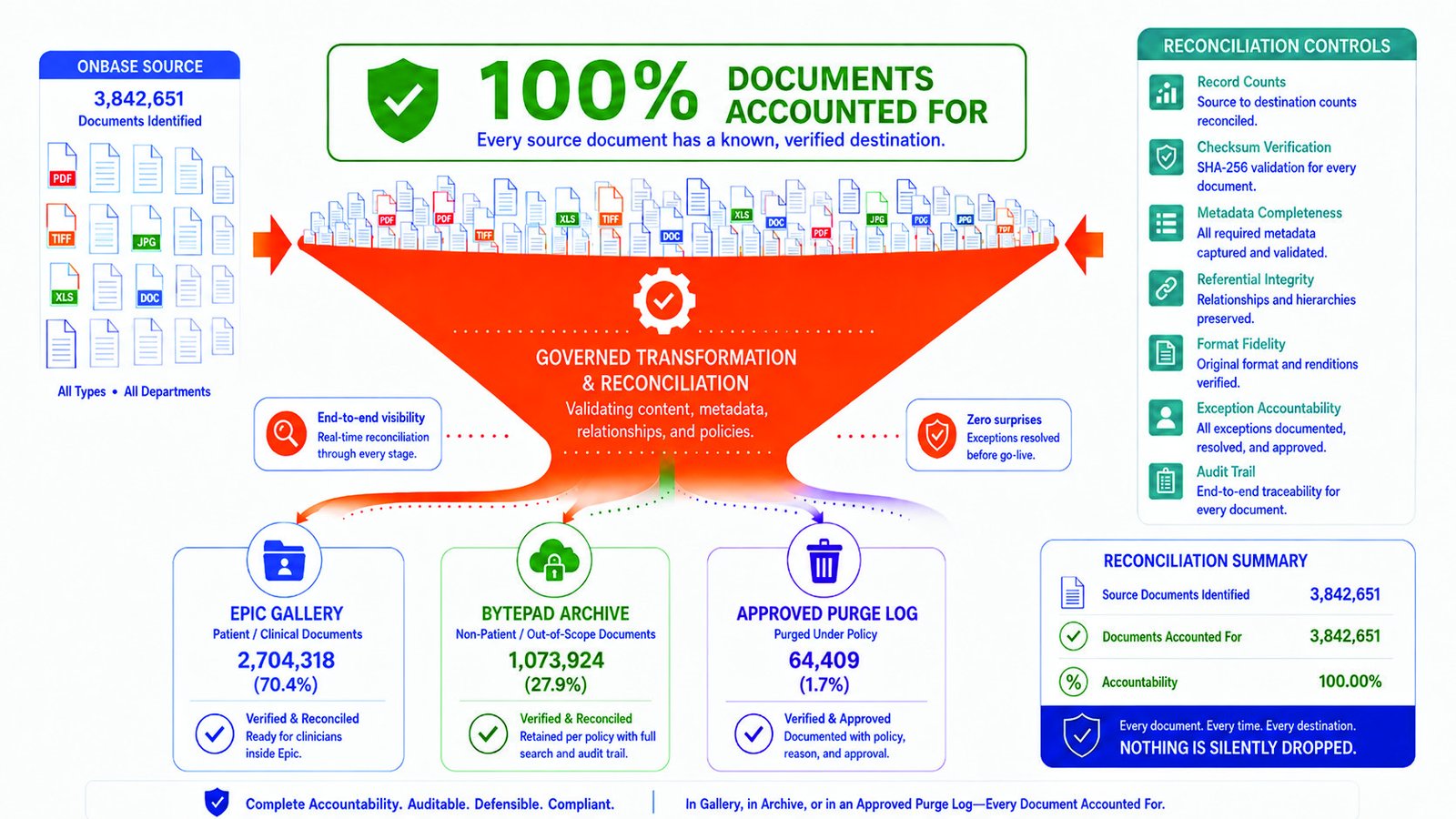
Data integrity is supported by seven controls applied throughout the migration: record-count reconciliation, checksum verification, metadata completeness, referential integrity, format fidelity, exception accountability, and end-to-end auditability. At completion, every in-scope source document has a verified disposition, Epic Gallery, the approved archive, or an authorized purge record.
Discovery & Inventory
Gate 1, Signed scope matrix with baseline counts
Disposition & Mapping
Gate 2, Approved disposition matrix and mapping spec
Extraction
Gate 3, Counts reconcile to baseline, variances explained
Transformation & Validation
Gate 4, Load-ready packages, zero critical exceptions
Ingestion & Reconciliation
Gate 5, 100% accountability, HIM acceptance sign-off
Delta Sync & Cutover
Gate 6, Final sync reconciled, OnBase read-only
Archive & Decommission
Gate 7, Archive certification, decommission executed
100% accountability. Zero surprises. Seven integrity controls apply to every batch, and no document moves to the next gate until the current one is proven complete.
One Migration Strategy, Two Destinations
A dual-destination architecture supports a comprehensive transition while ensuring every document category has an appropriate home. Patient and clinical documents move to Epic Gallery, where they are available inside the Epic workflow. Non-patient and out-of-scope documents can be retained in BytePad, the InterScripts data archiving platform hosted on Microsoft Azure, with retention schedules, legal hold, role-based access, and full-text retrieval.
Epic Gallery
70.4%
Patient & clinical documents, verified, reconciled, and ready for clinicians inside Epic.
BytePad Archive
27.9%
Non-patient / out-of-scope content, retained per policy with full search and a defensible audit trail.
Approved Purge Log
1.7%
Purged under policy, every record documented with reason, retention basis, and approval.
This approach lets organizations address content that is not intended for Gallery while maintaining access, governance, and retention. HR, finance, compliance, and credentialing records remain available in the archive without being forced into the clinical record. With a defined destination for both clinical and non-clinical content, the transition proceeds according to a single operational, compliance, and technology strategy.
The Business Case for Migration
The business case is shaped by the organization’s broader technology strategy, document volumes, operational requirements, and long-term content approach. As clinical document workflows consolidate within Epic, infrastructure, licensing, administration, integrations, security, and compliance responsibilities can all change as part of the transition.
Migration cost is influenced by total document volume, the number of distinct document types, metadata complexity, special handling requirements, and the disposition strategy for content. During discovery, each document class can be evaluated to determine whether it should migrate to Gallery, be retained in an approved archive, or be dispositioned per retention policy. Comparing current-state operating costs with migration, archive, and future-state operating costs is how health systems build a realistic case and choose the right timing.

Five Reasons Health Systems Choose InterScripts
One partner, two destinations
Clinical content moves to Epic Gallery; non-patient and out-of-scope content is retained in BytePad. A coordinated strategy with a defined destination for each document class.
Proven conversion discipline
A structured ETL methodology and a seven-element data-integrity framework, refined through complex healthcare conversions. Every batch follows documented controls and a defensible audit trail.
Dual-platform expertise
The team understands both OnBase content structures and Epic workflows, revision histories, annotations, forms, overlays, and metadata are evaluated during discovery and built into the design.
Dedicated migration capacity
Dedicated extraction and conversion resources support the project schedule. Capacity, sequencing, and throughput are planned around your Gallery timeline and implementation milestones.
Compliance built in
HIPAA-aligned controls, a BAA before data access, encryption in transit and at rest, legal-hold support, and document-level reconciliation are incorporated throughout the process.
Built for Speed, Priced for Sense
InterScripts provides dedicated extraction and conversion capacity for predictable scheduling and efficient execution, with scalable throughput and cost-effective delivery while maintaining HIPAA-aligned controls, including a BAA before data access and encryption in transit and at rest. A typical engagement runs approximately four to nine months, depending on document volume, the number of document types, metadata requirements, and overall conversion complexity. Detailed timelines are established after discovery, once scope, content characteristics, resource requirements, and the delivery plan are validated.
Are You Ready?
Readiness comes down to four areas: early planning, stakeholder alignment, data strategy, and a trusted partnership. Organizations should confirm that the plan accounts for extraction, transformation, validation, archiving, and the Gallery implementation timeline, not just the Epic build itself. Key stakeholders across HIM, clinical informatics, compliance, and non-clinical document ownership should be aligned on responsibilities, disposition decisions, and governance.
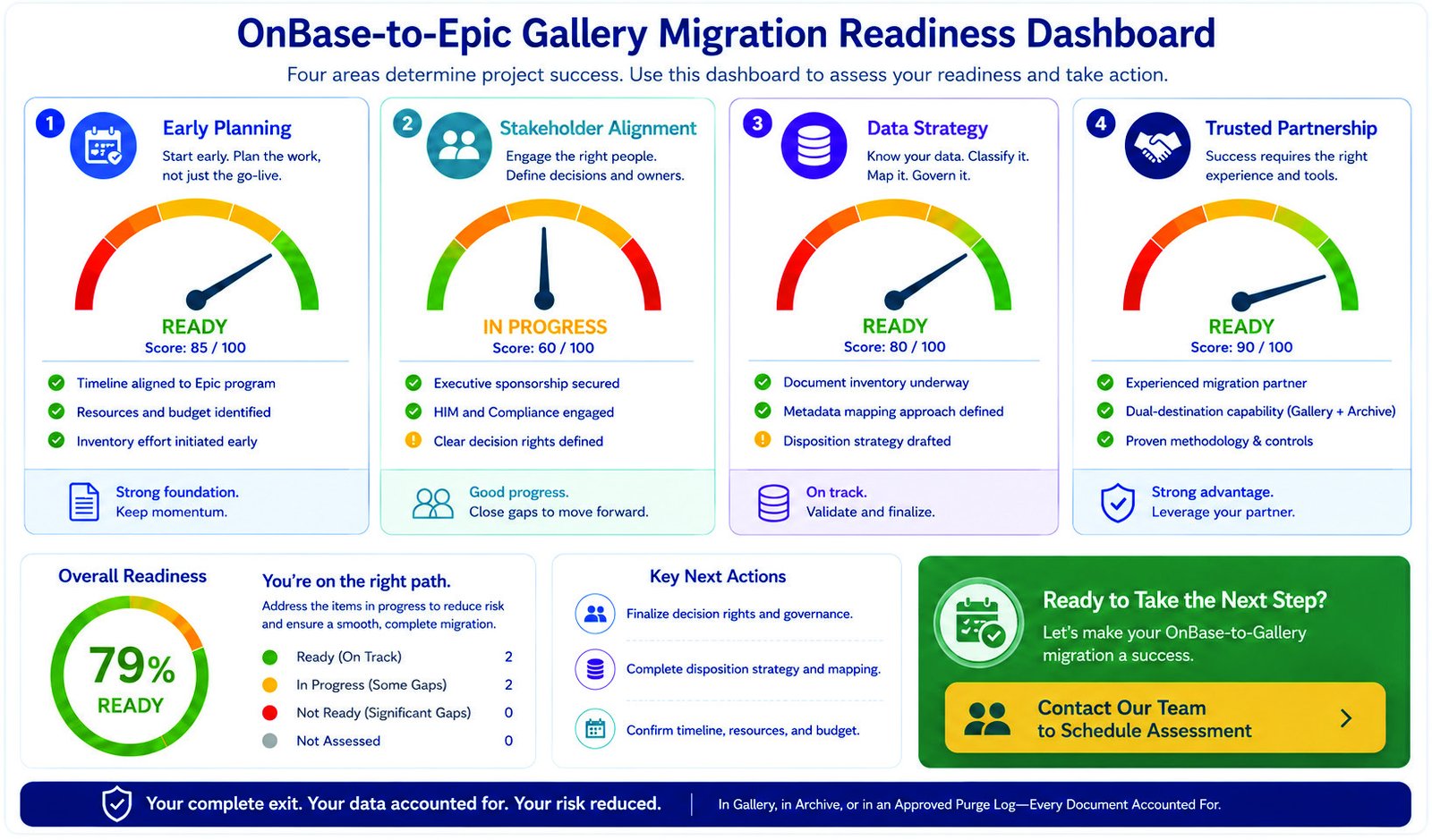
The quick check below is a condensed version of the full readiness checklist. If any row comes up mostly “no,” that row is your critical path.
| Readiness area | Quick check |
|---|---|
| Early planning | Gallery timeline confirmed with the Epic team. OnBase renewal dates documented. Budget covers extraction, transformation, and archiving. Internal bandwidth honestly assessed. |
| Stakeholder alignment | Executive sponsor named. HIM owns disposition. Clinical informatics has reviewed Epic workflows. HR, finance, legal, and credentialing are at the table. |
| Data strategy | Full inventory of document types, keywords, and volumes. Patient content separated from non-patient. Every class has a disposition. Edge cases catalogued. |
| Trusted partnership | Partner proven on both OnBase and Gallery. Dedicated extraction capacity. Validation methodology in writing. BAA before data access. |
Patient and clinical documents move to Epic Gallery, while non-patient and out-of-scope content is retained in BytePad, so every document has an appropriate destination.
InterScripts offers a no-cost OnBase footprint assessment to help organizations evaluate document types, volumes, metadata requirements, and migration considerations. The assessment provides an initial scope estimate and a phased migration plan to support informed project planning. Download the full white paper below, or contact our team to schedule your assessment.