

One standard. Two front doors. 24×7 support for the providers who deliver care and the patients who depend on it. Every hospital IT leader knows how the service desk performs at 10 AM on a Tuesday, very few can prove how it performs at 2 AM on a Sunday. This buyer’s guide gives CIOs, IT Directors, and CMIOs a clear standard to measure against, and the questions to ask before they buy.
The 2 AM Test
Every hospital IT leader knows how the service desk performs at 10 AM on a Tuesday. Very few can prove how it performs at 2 AM on a Sunday, when a night-shift nurse is locked out of the EHR, an on-call physician can’t retrieve imaging, and a patient is staring at a MyChart error about tomorrow’s procedure. Hospitals never close. Most IT support quietly does.
Between 6 PM and 7 AM, and across weekends and holidays, most health systems downgrade to a skeleton crew, a pager rotation, or an answering service, while clinical demand barely dips. Nurses still chart, medications are still scanned, EDs still admit, and patients still message. That mismatch makes after-hours performance the single most honest signal of service desk quality: at 2 AM, every daytime cushion is gone, and what remains is the desk’s true capability.
If a desk is good at 2 AM, it is good. The reverse is not true.
Where after-hours performance can hide
Weekly averages can make a contact center look better than it really performs. A desk may answer 92% of calls quickly during the day but only 45% overnight. Because fewer calls come in overnight, the blended weekly average can still look acceptable, but clinicians and patients calling at 2 AM experience the 45% service level, not the average. That is why every key metric, speed to answer, abandonment, first-contact resolution, and satisfaction, should be reported separately for business hours and after hours. If you cannot see the difference, you cannot manage it.
What It Takes to Operate a 24×7 Healthcare Contact Center
Providing true 24×7 support requires more staffing than many organizations expect. A healthcare contact center must cover 168 hours every week, including nights, weekends, holidays, training, PTO, breaks, and unexpected absences.
Using typical workforce-planning assumptions, keeping just one position continuously staffed can require more than five full-time employees. Once additional overnight and weekend coverage, supervision, and quality assurance are included, a health system may need approximately eight FTEs to establish a credible in-house 24×7 contact center.
| Coverage component | Hours / week | FTEs required |
|---|---|---|
| Continuous 24×7 coverage | 168 | 5.25 |
| Additional nights & weekends coverage | ~76 | 2.4 |
| Supervision / QA | , | 0.5+ |
| Typical in-house 24×7 staffing requirement | 168 | ≈ 8 FTE |
| Estimated annual staffing cost | , | $650K–$900K / year |
These figures are an industry planning example and do not represent InterScripts pricing or the cost of an InterScripts managed service. Actual internal costs vary based on labor market, benefits, staffing model, technology, and service requirements.
The question is not simply whether a health system can build a 24×7 contact center. It is whether maintaining the staffing, training, supervision, quality, and after-hours coverage required to operate one consistently is the best use of internal resources. A managed service provides an alternative by spreading those operational requirements across a larger, dedicated support organization.
One Standard, Two Front Doors
The modern healthcare service desk is really two missions sharing one standard. The Clinical Service Desk (CSD) keeps clinicians moving, and MyChart patient support keeps patients connected to their care. Both run 24×7, because neither a hospital nor its patients keep business hours. Buyers who scope only the clinician desk miss a third of the real workload; buyers who let patient calls bleed into the clinician queue degrade both.
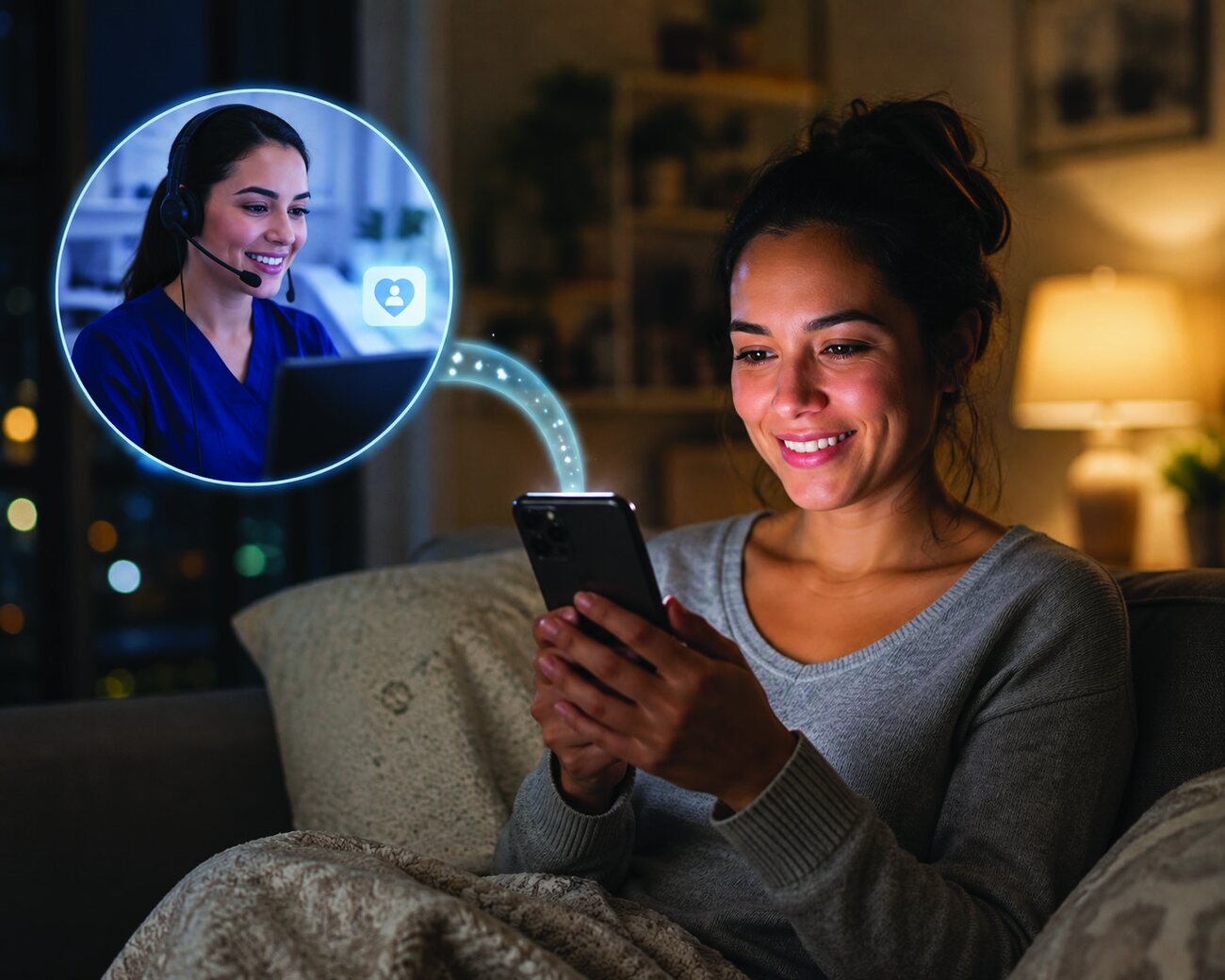
Clinical Service Desk (CSD), 24×7 for clinicians
- Epic fluency at Tier 1. 55–70% of hospital tickets touch the EHR. Tier 1 resolves lockouts, Hyperspace and order-entry questions, and downtime guidance instead of logging and routing.
- Triage by care impact. Priority is set by proximity to patient care, not caller rank, and the overnight analyst can declare a P1 and wake the right people without a supervisor’s blessing.
- Same standard at night. One trained team, one knowledge base, one QA bar across all 168 hours, no second-string overnight pool.
- Every ticket a workaround prevented. A borrowed login, a late downtime process, a verbally relayed order, the real cost of a weak desk never shows up in the ticket count.
MyChart Patient Support, 24×7 for patients
- Activation operations. Won or lost at first contact: code troubleshooting, identity verification, app and biometric login help, measured by activation success, not call counts.
- Proxy access done right. Parents, adult children, caregivers, the highest-risk category on the desk, handled with HIM and legal-reviewed decision trees, never on verbal assurance.
- Bilingual by design. Spanish-speaking analysts on staff, interpreter integration for long-tail languages, translated IVR and articles verified after hours, when it matters most.
- Patient hours, not business hours. Results anxiety at 9 PM, pre-procedure questions at 5:30 AM. Expect 1.5–3 contacts per active portal user per year, and budget for it separately.
A clinician who can’t log in and a patient who can’t activate are the same failure: care interrupted by IT. One desk standard must cover both.
What Good Looks Like
A strong healthcare service desk should perform consistently during the day and after hours. Do not rely only on overall averages, measure the same service levels at night, on weekends, and during holidays.
| Metric | Needs attention | Healthy | Best-in-class |
|---|---|---|---|
| First Contact Resolution | < 60% | 70–75% | 80%+ |
| Avg Speed of Answer | > 60 sec | 30–60 sec | < 30 sec |
| Abandonment | > 8–10% | 5–8% | < 5% |
| CSAT | < 80% | 90–95% | > 95% |
First Contact Resolution (FCR) matters most: it shows whether the issue was actually resolved without a transfer, callback, or repeat contact. For healthcare organizations, FCR should also include EHR-related support, not just basic IT requests.
The desk is a security perimeter
Recent breaches across industries followed one script: the attacker didn’t defeat the firewall, they called the help desk, posed as an employee, and talked their way into a password reset or an MFA re-enrollment. Healthcare is a prime target: large credential-rich workforces, high turnover, and a culture of urgency that attackers weaponize (“I’m a physician with a patient waiting”). And they deliberately call at 2 AM, when supervision is thinnest and the newest hire answers.
- Tiered, non-overridable caller verification, strongest proof for MFA changes and privileged actions; knowledge-based questions treated as weak.
- A no-exception culture, analysts empowered and protected to refuse a bypass, even from an “executive.” Every attacker impersonates a VIP.
- Adversarial testing, test your own desk annually; review results at the CIO/CISO level. Ask any vendor for the written procedure, the exception log, and the last test result. No answer is an answer.
The 8-Question Service Desk Check
Use these eight questions to quickly assess your current service desk. For each question, select Needs Attention or Meets the Standard. If you cannot answer with data, treat it as Needs Attention.
| # | Question | Needs Attention | Meets the Standard |
|---|---|---|---|
| 1 | Can you measure after-hours performance? | No separate after-hours reporting | Day and after-hours results reported separately |
| 2 | Who answers at 2 AM? | Answering service, pager, or one analyst | Trained analysts available 24×7 |
| 3 | Can Tier 1 resolve EHR issues? | Mostly logs and routes tickets | Resolves most common EHR issues at Tier 1 |
| 4 | Is patient-care impact used to set priority? | Generic IT priority rules | Patient-care impact drives priority 24×7 |
| 5 | Are service levels consistent after hours? | Performance drops or cannot be measured | Day and after-hours performance meet the same standard |
| 6 | Is MyChart patient support available 24×7? | Limited or mixed into the clinician desk | Dedicated support for activation, proxy access, and language needs |
| 7 | Is the desk protected from social engineering? | Verification can be bypassed | Strong verification with no exceptions |
| 8 | Do you understand the true cost of 24×7 support? | Total cost is unknown | In-house costs are measured and compared with managed |
How to read your results
Give yourself 1 point for every “Meets the Standard” answer.
| 7–8 | Strong 24×7 service desk |
| 4–6 | Good foundation, but important gaps remain |
| 0–3 | Significant gaps, especially in after-hours support |
The goal is simple: your healthcare service desk should provide the same dependable support at 2 AM as it does at 2 PM.
From Audit to Action

A strong 24×7 healthcare service desk should provide consistent support during the day and after hours. The next step is to understand where your current operation is performing well, where gaps exist, and what those gaps may be costing your organization.
Book a Service Desk Assessment
InterScripts offers a no-obligation Service Desk Assessment for hospitals and health systems. In two to three weeks, our team will:
- Review your service desk performance, including tickets, call data, CSAT, and after-hours results.
- Evaluate your 24×7 staffing and operating model and compare it with managed service alternatives.
- Benchmark key measures such as First Contact Resolution, speed to answer, abandonment, and CSAT.
- Review security and patient-support readiness, including social-engineering safeguards and MyChart support.
- Provide a clear assessment and action plan showing what is working, what needs attention, and recommended next steps.
For health systems operating their own 24×7 contact center, we can also evaluate staffing and cost against the typical in-house planning requirements discussed in this paper, including the approximately 8-FTE model. These benchmarks are not InterScripts pricing.
Bring your last 90 days of desk data. We’ll bring the 2 AM standard.
Talk to InterScripts, info@interscripts.com · (703) 635-7676
Who We Are
InterScripts delivers comprehensive IT services and solutions across multiple industries, supporting both commercial enterprises and government organizations. Our core capabilities include system integration, application development, application support, data extraction, data conversion, and enterprise data management.
We help organizations modernize operations by strengthening data governance frameworks, integrating enterprise systems, and streamlining workflows, reducing operational costs, minimizing risk, and improving data accessibility. InterScripts is a leader in data management solutions, offering secure data archival and legacy system decommissioning through our platform, BytePad.
Sources and notes. Benchmark bands synthesize published healthcare contact-center and IT service desk benchmark data (2024–2026), including healthcare-typical ASA of 30–60 seconds, abandonment of 5–8% with >10% as an investigation threshold, cross-industry FCR averages of ~70–74%, and 80/20–80/30 service-level conventions. Staffing and cost figures are planning estimates based on a 20% shrinkage assumption and analyst base salaries of $55K–$65K with benefits and employer costs adding 25–30%; validate against your labor market. Informational only; not legal or compliance advice.